AN ITALIAN ADVENTURE
Intention & Professional application
For this module I intend to produce at least 10 architectural images, using material collected on my recent visit to Naples and the surrounding area.
These will form a portfolio of images which can be used in a professional application, for example to illustrate guide and travel journals, as art work for books, magazines or calenders, in photojournalism or as illustrations in architectural magazines.
Stimulus & Influences
My stimulus for this has been my recent visit to Italy and the desire to capture a photographic record of the amazing buildings I have seen there, with all the influences that have come from the peoples of ancient and modern civilisations, who have made a home in this part of the world.
I have been influenced by historians and archaeologists past and present, fist during my school years when ancient history was part of the curriculum and latterly by some of the excellent history programmes shown on television.
Equipment & Media
Since this trip to Italy is primarily a touring holiday, I have only been able to take one camera due to luggage weight restrictions. I will therefore be using my Canon EOS 5D MK11 with 24 - 70mm lens and polarising filter where necessary. I do not have a tilt and shift lens available and feel that this will not be needed since it is an artistic impression I want to achieve. It would be nice to have a tripod available to enable me to take some shots in low light or at night, but unfortunately this is not possible.
I will publish the finished photographs in a portfolio available via the internet, either on a dedicated photosharing website or on blogger. I feel this is more convenient since I will not have to carry around a bulky portfolio of printed photographs and can reach a larger audience without having to be physically present myself.
Techniques
Since my portfolio is not intended for illustration of technical journals, I would like to capture an artistic impression of architecture, rather than a technically correct photograph, showing no perspective for example. On the contrary I prefer the exagerated, elongated look that is achieved by standing close to a structure and shooting upwards.
As well as photographing buildings as a whole, I want to show detail in the architecture by taking close-up shots of interesting decoration and fittings, internally as well as externally. In order to isolate detail, I want to use, where possible due to lighting conditions, a wide aperture in order to throw surroundings distractions, out of focus.
Lighting
I do not have any flash equipment available and could not carry it with me due to the nature of the trip, so I will be relying on ambient light. This may be problematical since many churches and museums have small windows which let in only a limited amount of light. However, this can provide some dramatic shafts of light which will give exciting results.
If light levels are low I will have to increase ISO, I have up to a reading of 6400, which can be expanded to 12800 and 25600 in very extreme cases. I anticipate keeping the iso to 2500 and lower where possible, since at higher readings picture quality deteriorates.
Health & Safety
Since I am taking photographs as a tourist on holiday and in public places, I should not need any special permissions. The general public and authorities seem to be well used to tourists snapping away and I have never been challenged as to what I am doing. However, I would not try to take pictures in a sensitive location, such as a police station or army barracks for example, unless I was commissioned to do so. I would then have to obtain the necessary permissions from any authorities involved.
I am always sensitive as to the reactions of other people whom I may capture in my photographs, if anyone objected I would discontinue and would not try to photograph children unless given permission by their parent or responsible adult.
The other considerations relate to personal safety, trips or falls, traffic and obstructions, climbing or making myself a hazard by obstructing others, or personal safety as in being attacked if out alone or threatened in a robbery.
Showing posts with label 305d3. Show all posts
Showing posts with label 305d3. Show all posts
Tuesday, 23 November 2010

Wednesday, 27 October 2010
NAPLES STREET PICTURES
None of these photographs have been put through photoshop

I saw this shot as we alighted from the coach when we first arrived in Naples. We had walked across a plaza full of parked cars and scooters and wanted to walk over to the Duomo ,(Naples cathedral) in the background. I noticed that almost everyone was sitting with their backs to this fabulous view, it remindes me of a photograph by Gary Winogrand .
The sun was so bright I had difficulty with exposure and tried to get a balance between the bright background and dark foreground in anticipation that I would be able to correct in photoshop. What I should have done was take at least two shots, one for each exposure level in order to blend them later. I like the composition though with busy people adding interest in the foreground with a figure in the centre looking into the view.
The sun was so bright I had difficulty with exposure and tried to get a balance between the bright background and dark foreground in anticipation that I would be able to correct in photoshop. What I should have done was take at least two shots, one for each exposure level in order to blend them later. I like the composition though with busy people adding interest in the foreground with a figure in the centre looking into the view.
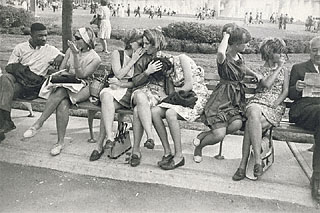
World's Fair, New York 1964
Here all the interest is on the people, with the viewer eavesdropping on their conversations. The 'eye' naturally reads a photograph from left to right and a slight drop off to the right keeps your eye travelling through the area of interest, drawing attention to the central figures by the 'frame' of the men at either end.

I loved the colour of these city buildings although bright sunlight has bleached out the facing building. Here again exposure was difficult because of the bright sunlight and shadows cast by tall buildings. It was the colour 'Pompei red' and repeated window decoration which I found interesting, I think the arches in bottom left draw you into the picture and the bright patch on sunlight takes you up to examine the pattern of the windows.

It was the taxis lined up two abreast with figures on top of the arches looking down that drew me to this shot.
Here taxis parked form a pattern, also using the rule of thirds to position towering pillars travelling up and figures forming a full stop at the top.

It was a great day for washing. Long sheets hanging emphasise the narrowness of the street and encourage you to look up into the view and examine the repeated balconies.

This building was really crumbling with age but had new additions stuck all over it, with a woman gazing out of a giant poster. I liked the way she was placed in the bottom right with a white scooter in front.

For sale signs stuck on a crumbling wall, it was the image of Vertruvian man with Leonardo printed over it that caught my attention. Repeated posters form a pattern with their shiny covering of plastic contrasting with the crumbly texture of the wall.

There were lots of street vendors but I had to get a shot of Barbie on her bicycle, the trouble was they expected me to buy as well.
A diagonal compostion seemed best here since Barbie was larger and would have obscured the figures from the other direction, by focusing on the nearest figures and letting Barbie fall slightly out of focus, I have encouraged the viewer to look at the focused area first then travel throught to top left. I thought this added more interest rather than a straight, full on shot.
A diagonal compostion seemed best here since Barbie was larger and would have obscured the figures from the other direction, by focusing on the nearest figures and letting Barbie fall slightly out of focus, I have encouraged the viewer to look at the focused area first then travel throught to top left. I thought this added more interest rather than a straight, full on shot.

More washing, with scooters caught in a strip of light.
Yellow topped bollards formed an avenue into the street with the action caught in a narrow strip of light between buildings. Washing hanging draws you upwards with the strip of sunlight almost acting as an arrow to the focal point of the riders.

I suppose the strip of high contrast road and sky draws you into the picture, but I also wanted the people passing the time of day, standing in the shade.

I like his pink scooter, very macho.
The rider here is placed in the bottom third of the picture with his head slightly off centre and looking to the side, he forms a focal point for this street scene with towering buildings and sunlight behind pointing down to the action.
The rider here is placed in the bottom third of the picture with his head slightly off centre and looking to the side, he forms a focal point for this street scene with towering buildings and sunlight behind pointing down to the action.

Lots of interesting local shops in the backstreets.
Although slightly underexposed, I like this shot of a street market, all the action is happening in the bottom left with the vendor in his pink shirt being the main focal point. The yellow building wall encourages you to look upwards and then down the shaft of light back to the action behind the vendor. There are lots of textures here with leafy vegetables, smooth yellow wall and crumbling wall above.
Although slightly underexposed, I like this shot of a street market, all the action is happening in the bottom left with the vendor in his pink shirt being the main focal point. The yellow building wall encourages you to look upwards and then down the shaft of light back to the action behind the vendor. There are lots of textures here with leafy vegetables, smooth yellow wall and crumbling wall above.

This cafe in a very grand setting was patronised by lots of smart people.
It is interesting how the tables line up, pointing to a view, framed by an archway, of repeating patterns of windows. Here again I used the 'rule of thirds' in composition.
It is interesting how the tables line up, pointing to a view, framed by an archway, of repeating patterns of windows. Here again I used the 'rule of thirds' in composition.

People in this shot illustrate the scale of the building, with arches and dome carrying pattern up through the shot.

Still Naples, with a couple of guys working on their boat. The main focal point is the boat in the bottom left with figures slightly below and to the right of centre point. Boats moored, hills in the distance any sky make up layers of interest and add perspective.

The beach is very much a part of city life with local people spending alot of their free time there since they have no private outside space.
I think the white chair forms a focal point, with the grape vine separating and adding perspective to the layers of boats and city buildings.
Wednesday, 20 October 2010
LECTURE - EDWARD SWINDEN

I attended a lecture at Burton College today given by Ed Swinden a young photographer, based in Manchester, who has recently won the first 'Shoot the Street' competion run by British Journal of Photography and the Format Photography Festival in Derby. He has a solo exhibition of his work running till April 2011.

He is exhibiting a series of photographs featuring a single person, going about their daily lives, caught in a strip of illumination, creating an almost abstract image.
Using the strong contast between light and dark as a metaphor for our daily lives, often oppressed by the system, as in the towering surroundings.

Ed came to photography after dropping out as a physcology student and going into journalism, writing for various newspapers and the BBC. He soon found out he preferred photography and went freelance about 6 years ago. He has worked as a photographer for the BBC on Doctor Who, NME magazine photographing various bands and Haymarket magazine photographing celebrities and various work for University of Manchester.

Ed enjoys street photography because it is fast, discreet and interacts with people, which I find a bit difficult to understand, since if you are fast and discreet you do not have much time to interact with the subject, surely the purpose is to capture the image before it changes, unless of course you have set up the shot, you would then have to interact with the subject to get them to repeat their actions. He says he does not use image manipulation in his photography, for example he has not inserted the figures, however, he used one photo to show how a mundane shot was turned into something more graphic and exciting, by underexposing a large part of the image, giving it a large black area.
 However, I do agree that street photography is a good way to train your eye as a photographer, searching out the juxtaposition of objects and illustrating the comedy of everyday life. Ed wanted to capture the in between times, when nothing much was happening, which is often most of the time, and looking at this series of shots, I agree, this is what he has achieved.
I admire the technical expertise and discipline needed to achieve a set of images in this vein, but for myself I prefer more information in my pictures. I could benefit from being more concentrated and training myself to be more disciplined and paring things down somewhat, but I just find everything so inspiring, especially when I am travelling, that I just want to capture it all.
Ed offered some good advice for people wanting to make a career of photography;
- look at lots of good and rubbish work and remember the names of the great photographers,
- practice, so that technical stuff is automatic,
- know what is current and 'in' but don't copy everyone else,
- try every technique and genre to see what you are good at and enjoy,
- use yourself as a model to practice lighting techniques,
- learn how light works,
- have projects going forwards,
- network, make the most of your contacts.


SOURCES - Lecture by Edward Swinden at Burton College 20/10/10
- web sites, photo.net
edswinden.co.uk
formatfestival.com
bjp-magazine.com

Ed enjoys street photography because it is fast, discreet and interacts with people, which I find a bit difficult to understand, since if you are fast and discreet you do not have much time to interact with the subject, surely the purpose is to capture the image before it changes, unless of course you have set up the shot, you would then have to interact with the subject to get them to repeat their actions. He says he does not use image manipulation in his photography, for example he has not inserted the figures, however, he used one photo to show how a mundane shot was turned into something more graphic and exciting, by underexposing a large part of the image, giving it a large black area.

I admire the technical expertise and discipline needed to achieve a set of images in this vein, but for myself I prefer more information in my pictures. I could benefit from being more concentrated and training myself to be more disciplined and paring things down somewhat, but I just find everything so inspiring, especially when I am travelling, that I just want to capture it all.
Ed offered some good advice for people wanting to make a career of photography;
- look at lots of good and rubbish work and remember the names of the great photographers,
- practice, so that technical stuff is automatic,
- know what is current and 'in' but don't copy everyone else,
- try every technique and genre to see what you are good at and enjoy,
- use yourself as a model to practice lighting techniques,
- learn how light works,
- have projects going forwards,
- network, make the most of your contacts.


SOURCES - Lecture by Edward Swinden at Burton College 20/10/10
- web sites, photo.net
edswinden.co.uk
formatfestival.com
bjp-magazine.com